Artificial Intelligence in the US–Israel–Iran War: An Islamic Ethical Perspective on Humanity and Persons with Disabilities
Modern warfare is undergoing a profound transformation. Artificial Intelligence (AI), once seen primarily as a tool for economic and technological advancement, has now entered the battlefield. The ongoing tensions involving the United States, Israel, and Iran have highlighted how AI can shape military decision-making, intelligence analysis, and targeting processes.
GENERAL
Abdul Waheed Muhammad Arif
3/5/20264 min read
Artificial Intelligence in the US–Israel–Iran War: An Islamic Ethical Perspective on Humanity and Persons with Disabilities
Introduction
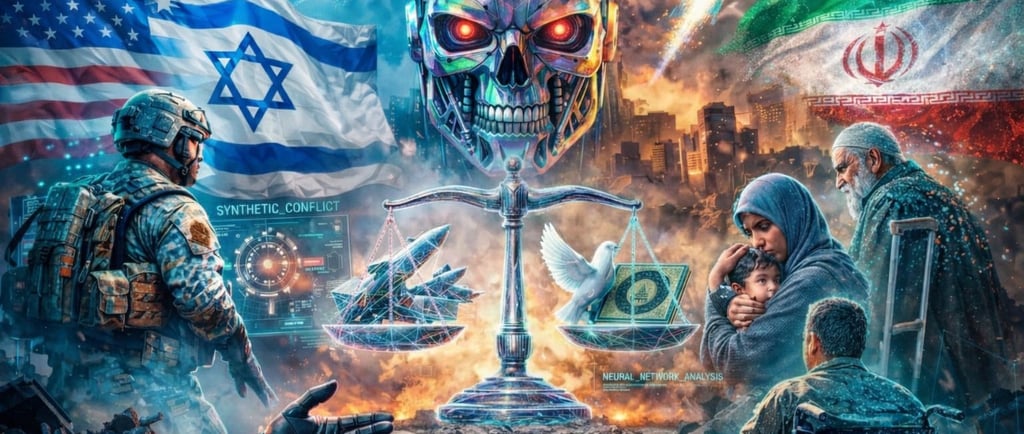
Modern warfare is undergoing a profound transformation. Artificial Intelligence (AI), once seen primarily as a tool for economic and technological advancement, has now entered the battlefield. The ongoing tensions involving the United States, Israel, and Iran have highlighted how AI can shape military decision-making, intelligence analysis, and targeting processes.
While AI promises efficiency and precision, it also raises deep ethical questions. When algorithms influence decisions about life and death, humanity must ask: Who is accountable? Is technological warfare morally acceptable? And how does it affect the most vulnerable members of society, including Persons with Disabilities (PWDs)?
Examining these issues through an Islamic ethical lens provides a powerful framework to evaluate the morality of AI-driven warfare.
AI in Modern Warfare
AI is now integrated into several aspects of modern conflict:
1. AI-Based Target Identification
Military systems increasingly use AI to analyze large volumes of intelligence data, including satellite images, communications intercepts, and surveillance footage. These systems can rapidly identify potential military targets.
For example, the Israeli military has reportedly used AI systems such as “Lavender” and “The Gospel” to analyze data and recommend bombing targets. These tools can process massive intelligence datasets and generate target lists far faster than human analysts.
However, critics warn that such systems may misidentify individuals and increase the risk of civilian casualties.
2. Accelerating Military Decision-Making
AI can drastically shorten the time between identifying a target and launching an attack, often called the “kill chain.”
Recent reports suggest that AI tools were used to analyze intelligence and prioritize targets during military operations involving Iran. These systems helped process large datasets and accelerate operational planning.
While this technological speed may provide strategic advantage, it raises concerns about reduced human oversight and the possibility of mistakes.
3. Autonomous and AI-Assisted Weapons
Modern warfare increasingly incorporates:
AI-guided drones
automated surveillance systems
predictive military analytics
For instance, recent operations reportedly used low-cost suicide drones and AI-assisted targeting systems, illustrating the growing reliance on technology-driven warfare strategies.
These developments suggest that future wars may involve even greater levels of automation.
Ethical Questions Surrounding AI Warfare
The integration of AI into warfare raises several ethical concerns.
Accountability
If an AI system recommends a target that leads to civilian casualties, who is responsible?
The programmer?
The military commander?
The algorithm itself?
This diffusion of responsibility can weaken accountability in war.
Loss of Human Judgment
Human soldiers traditionally make decisions based on ethical reasoning, situational awareness, and empathy. AI systems operate on data patterns and algorithms.
This may result in “algorithmic warfare,” where machines indirectly determine human survival.
Increased Scale of Violence
AI systems can generate thousands of potential targets quickly. Some analysts warn that such tools may transform warfare into an industrialized process of targeting, increasing the scale and speed of violence.
Islamic Ethics and the Use of AI in War
Islamic teachings provide a strong ethical framework regarding warfare.
1. Sanctity of Human Life
The Qur’an states:
> “Whoever kills a soul… it is as if he had slain mankind entirely.”
(Qur’an 5:32)
This verse highlights the extreme seriousness of taking human life.
In Islamic ethics, war is permitted only under strict conditions such as self-defense, and even then it must follow clear moral rules.
2. Protection of Civilians
Prophet Muhammad ﷺ instructed Muslim armies not to harm:
women
children
elderly people
religious monks
civilians
These teachings emphasize human dignity and restraint in warfare.
AI warfare challenges these principles if systems fail to distinguish civilians from combatants.
3. Moral Responsibility
Islam emphasizes niyyah (intention) and human accountability. Delegating life-and-death decisions to algorithms risks undermining the ethical responsibility required in Islamic law.
Thus, from an Islamic perspective, AI may assist humans but should never replace moral judgment.
Impact of AI Warfare on Persons with Disabilities (PWDs)
One of the most overlooked dimensions of war is its impact on Persons with Disabilities.
1. Increased Vulnerability
PWDs face significant challenges during armed conflicts:
limited mobility
visual or hearing impairments
difficulty accessing evacuation routes
dependence on medical equipment
In AI-driven warfare, where attacks may occur rapidly based on algorithmic decisions, PWDs may have even less time to respond or escape.
2. Disruption of Medical Infrastructure
Wars often destroy:
hospitals
rehabilitation centers
disability support services
PWDs who rely on medication, assistive technologies, or caregivers may be severely affected.
3. Ethical Marginalization
Most military AI systems are designed primarily around strategic efficiency, not humanitarian vulnerability.
This means:
disability considerations are rarely included in targeting models
civilian vulnerability data may not be prioritized
From both humanitarian and Islamic perspectives, neglecting vulnerable populations is ethically unacceptable.
AI as a Tool for Peace Instead of War
Despite these risks, AI has the potential to support peace-building rather than destruction.
Possible positive uses include:
predicting humanitarian crises
improving disaster response
supporting accessibility technologies for PWDs
monitoring ceasefire violations
In this sense, AI should serve human dignity, justice, and compassion, rather than accelerating warfare.
Conclusion
The use of Artificial Intelligence in conflicts involving the United States, Israel, and Iran represents a turning point in the history of warfare. AI offers speed, efficiency, and advanced data analysis, but it also introduces profound ethical dilemmas.
From an Islamic perspective, warfare must always prioritize justice, restraint, and protection of human life. Delegating critical decisions to machines risks undermining these moral foundations.
Moreover, the impact on vulnerable populations, particularly Persons with Disabilities, highlights the urgent need for inclusive ethical frameworks in military technology.
Ultimately, humanity must decide whether AI will become a tool of destruction or a tool of compassion and peace.
The answer to that question will shape not only the future of warfare but the future of humanity itself.