Beyond Vulnerability: How Persons with Disabilities Can Contribute to National and International Conflict Response Through Technology
Discussions surrounding war and conflict often portray Persons with Disabilities (PWDs) solely as vulnerable populations requiring protection. While protection remains essential, this perspective overlooks an equally important reality: persons with disabilities are capable contributors to national resilience, conflict response, and global security efforts.
GENERAL
Abdul Waheed Muhammad Arif
3/3/20263 min read
Beyond Vulnerability: How Persons with Disabilities Can Contribute to National and International Conflict Response Through Technology
Discussions surrounding war and conflict often portray Persons with Disabilities (PWDs) solely as vulnerable populations requiring protection. While protection remains essential, this perspective overlooks an equally important reality: persons with disabilities are capable contributors to national resilience, conflict response, and global security efforts.
In an era where warfare is increasingly digital, technological, and knowledge-driven, participation in national and international conflict response is no longer limited to physical combat. Technology has transformed modern conflict into a multidimensional space where intellectual capability, innovation, and remote engagement play decisive roles — creating unprecedented opportunities for PWD inclusion.
The Transformation of Modern Warfare
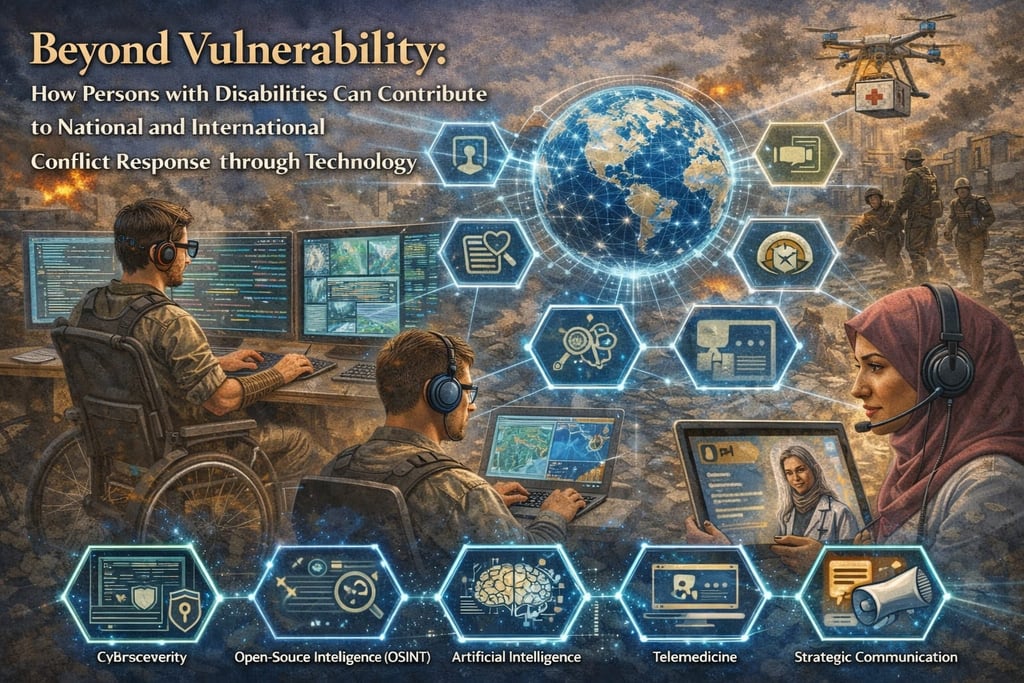
Contemporary conflicts extend beyond battlefields into cyberspace, information networks, artificial intelligence systems, humanitarian coordination platforms, and digital diplomacy.
Modern warfare now includes:
- Cybersecurity operations
- Data intelligence analysis
- Information and media monitoring
- Remote medical assistance
- Humanitarian logistics coordination
- Strategic communication and diplomacy
These domains rely primarily on cognitive skills rather than physical mobility, enabling meaningful participation by persons with disabilities.
Technological Pathways for National Contribution
1. Cybersecurity and Digital Defense
PWDs with expertise in programming, ethical hacking, or data security can contribute directly to national cyber defense systems. Protecting digital infrastructure such as hospitals, banking systems, and communication networks has become a frontline responsibility in modern conflicts.
Remote cybersecurity roles allow participation regardless of physical limitations.
2. Artificial Intelligence and Data Analysis
Artificial Intelligence assists governments in predicting conflict risks, analyzing satellite imagery, monitoring misinformation, and managing crisis responses.
Individuals with disabilities trained in AI and analytics can support:
- Threat assessment models
- Conflict prediction systems
- Disaster-response optimization
- Intelligence interpretation
Such contributions strengthen national preparedness without requiring battlefield presence.
3. Strategic Communication and Counter-Misinformation
Information warfare plays a central role in modern geopolitical conflicts. Social media monitoring, fact-checking initiatives, and digital diplomacy campaigns require analytical thinking and communication skills.
PWDs can actively participate in:
- Countering propaganda
- Promoting verified information
- Supporting psychological resilience through online engagement
- Managing crisis communication platforms
International Contributions Through Technology
1. Remote Humanitarian Coordination
Global humanitarian organizations increasingly rely on digital platforms for coordination. Persons with disabilities can assist international agencies through:
- Data management for refugee support programs
- Accessibility auditing of aid systems
- Translation and communication services
- Virtual crisis mapping
Their lived experience often enhances inclusive humanitarian planning.
2. Telemedicine and Psychological Support
Healthcare professionals or trained volunteers with disabilities can provide remote consultations and mental health support to war-affected populations through telehealth systems.
Digital platforms eliminate geographical and mobility barriers, enabling global service delivery.
3. Open-Source Intelligence (OSINT)
Open-source intelligence gathering — analyzing publicly available information — has become essential for monitoring human rights violations and conflict developments.
PWD researchers and analysts can contribute internationally by documenting events, supporting accountability mechanisms, and assisting global policy institutions.
Innovation Driven by Lived Experience
Persons with disabilities frequently develop adaptive problem-solving skills due to everyday accessibility challenges. These experiences position them uniquely to design inclusive wartime technologies such as:
- Accessible emergency communication systems
- Assistive evacuation technologies
- Inclusive disaster-response applications
- AI systems sensitive to vulnerable populations
Innovation emerging from disability perspectives strengthens both humanitarian effectiveness and national resilience.
Ethical Participation and Inclusive Security
Inclusive participation aligns with evolving international security concepts emphasizing human security rather than purely military strength. National resilience today depends on mobilizing all segments of society.
Governments and international institutions should therefore:
- Provide accessible technological education
- Include PWDs in digital defense initiatives
- Promote remote service opportunities
- Recognize disability inclusion as a strategic asset
Participation must remain voluntary, ethical, and consistent with humanitarian law.
Redefining Contribution in the 21st Century
The notion that contribution during conflict requires physical combat belongs to an earlier era. The digital transformation of warfare has expanded the meaning of service to include intelligence, innovation, communication, and humanitarian leadership.
Persons with disabilities are not merely survivors of conflict — they are analysts, innovators, technologists, and peace contributors capable of strengthening national and international stability.
Conclusion: Inclusion as Strategic Strength
As global conflicts evolve alongside technological advancement, inclusive participation becomes a necessity rather than an ideal.
Empowering persons with disabilities to contribute through technology transforms national defense and international cooperation into more resilient, ethical, and representative systems. A secure future will depend not only on military capability, but on how effectively societies enable every citizen — regardless of ability — to participate in safeguarding humanity.