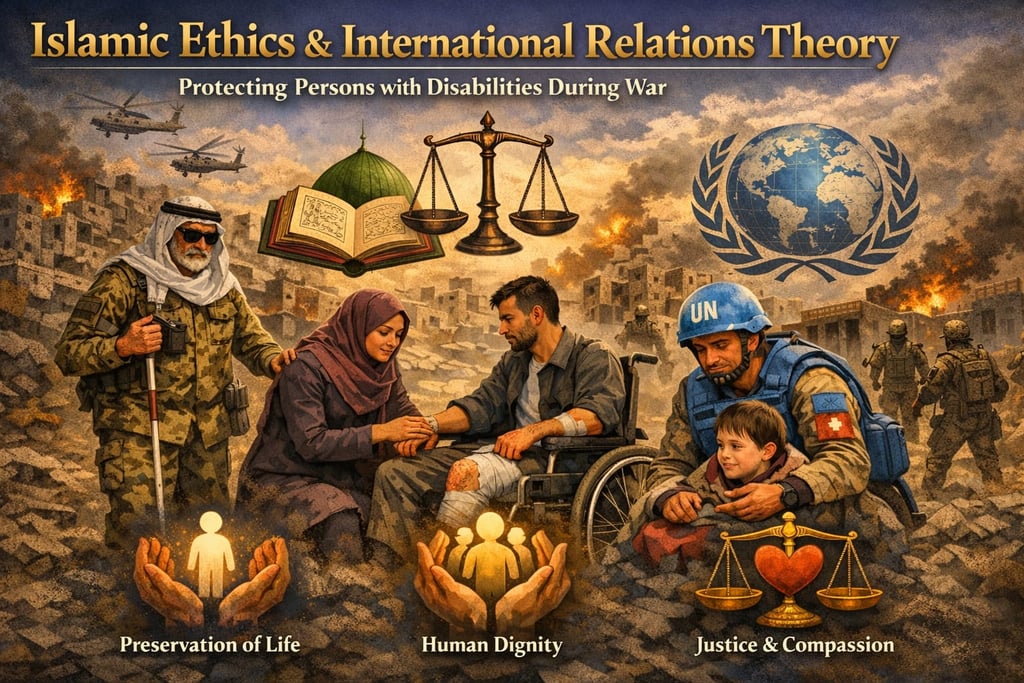
Islamic Ethics and International Relations Theory: Protecting Persons with Disabilities During War
The rapidly transforming global order has intensified debates surrounding ethics, warfare, and humanitarian responsibility. While contemporary International Relations (IR) theory often discusses power, security, and national interests, insufficient attention is given to morally vulnerable populations — particularly Persons with Disabilities (PWDs) during armed conflict.
GENERAL
Abdul Waheed Muhammad Arif
2/26/20263 min read
Islamic Ethics and International Relations Theory: Protecting Persons with Disabilities During War
The rapidly transforming global order has intensified debates surrounding ethics, warfare, and humanitarian responsibility. While contemporary International Relations (IR) theory often discusses power, security, and national interests, insufficient attention is given to morally vulnerable populations — particularly Persons with Disabilities (PWDs) during armed conflict.
Islamic ethical traditions, when examined alongside modern International Relations theory, provide a powerful normative framework for understanding how societies and states should protect persons with disabilities in times of war.
War, Vulnerability, and the Changing Global Order
Modern conflicts increasingly involve urban warfare, technological weapons, displacement crises, and hybrid security threats. In such environments, persons with disabilities face disproportionate harm due to mobility limitations, communication barriers, disrupted healthcare systems, and exclusion from evacuation mechanisms.
Traditional realist approaches in International Relations prioritize state survival and strategic advantage. However, emerging humanitarian and constructivist perspectives emphasize human security — shifting focus from territorial protection to the protection of human dignity.
Islamic ethics anticipated this human-centered security model centuries ago.
Islamic Ethical Foundations of Protection During Conflict
Islamic teachings establish strict moral limitations on warfare. Classical Islamic jurisprudence explicitly prohibits harm to non-combatants, including:
the elderly
women and children
the sick
monks and civilians unable to fight
Persons with disabilities fall clearly within these protected categories.
The ethical principles derived from the Qur’an and Prophetic traditions emphasize:
1. Preservation of Life (Hifz al-Nafs)
A central objective of Islamic law (Maqasid al-Shariah) is the protection of human life. During war, safeguarding vulnerable individuals becomes a collective obligation rather than voluntary charity.
2. Human Dignity (Karamah al-Insan)
Islam recognizes inherent dignity for every human being regardless of physical or cognitive ability. Disability does not reduce moral worth or social entitlement.
3. Justice and Compassion (‘Adl and Rahmah)
Islamic governance requires justice balanced with mercy. Assistance to vulnerable populations, including PWDs, represents an ethical duty embedded within governance itself.
Islamic Ethics and International Relations Theory
When viewed through IR theoretical lenses, Islamic ethics contributes significantly to normative global governance debates.
Beyond Realism: Ethical Responsibility in Warfare
Realism assumes states act primarily in pursuit of power and survival. Islamic ethical thought challenges unrestricted warfare by imposing moral accountability even during conflict.
This introduces an ethical restraint mechanism comparable to modern Just War Theory but rooted in divine accountability rather than political agreement alone.
Constructivism and Norm Formation
Constructivist IR theory argues that international norms shape state behavior. Islamic humanitarian principles historically influenced rules of engagement, prisoner treatment, and civilian protection.
Incorporating disability inclusion into wartime norms aligns with both Islamic ethical tradition and evolving global humanitarian law.
Human Security Paradigm
Islamic governance prioritizes societal welfare (Maslahah). This parallels the modern Human Security framework, which emphasizes protection from fear, want, and structural vulnerability.
Supporting PWDs during conflict therefore becomes not only a humanitarian act but a security imperative.
Responsibilities of Modern States and Institutions
Applying Islamic ethical principles within contemporary international politics requires practical implementation:
Inclusive evacuation planning for persons with disabilities
Accessible humanitarian communication systems
Protection of medical and rehabilitation infrastructure
Priority aid distribution for vulnerable populations
Technological accessibility in emergency response mechanisms
Muslim-majority states, in particular, possess both ethical and civilizational responsibility to operationalize these principles within defense and humanitarian policy.
PWDs as Participants in Peacebuilding
Islamic ethics does not frame vulnerable populations solely as recipients of care. Consultation (Shura) and social participation are foundational governance principles.
Persons with disabilities must therefore be included in peacebuilding dialogue, humanitarian planning, and post-conflict reconstruction processes. Their lived experiences strengthen resilience-oriented policy frameworks.
Toward an Ethical Global Order
As international relations evolve amid technological rivalry and geopolitical instability, moral frameworks are increasingly necessary to humanize global politics.
Islamic ethics offers a vision where warfare remains constrained by compassion, justice, and responsibility toward the most vulnerable members of society.
Protecting persons with disabilities during war is not merely a humanitarian preference — it is an ethical obligation grounded in faith, law, and universal human dignity.
An inclusive global order will ultimately depend not on military dominance, but on the moral capacity of societies to safeguard those least able to protect themselves.