
Technology as a Lifeline: Assisting Persons with Disabilities During Wars in a Rapidly Changing Global Order
The contemporary global order is undergoing profound transformation. Rising geopolitical tensions, armed conflicts, hybrid warfare, and technological competition among nations are reshaping how wars are fought and experienced. Amid these changes, one group remains disproportionately vulnerable yet frequently overlooked — Persons with Disabilities (PWDs).
GENERAL
Abdul Waheed Muhammad Arif
3/2/20263 min read
Technology as a Lifeline: Assisting Persons with Disabilities During Wars in a Rapidly Changing Global Order
The contemporary global order is undergoing profound transformation. Rising geopolitical tensions, armed conflicts, hybrid warfare, and technological competition among nations are reshaping how wars are fought and experienced. Amid these changes, one group remains disproportionately vulnerable yet frequently overlooked — Persons with Disabilities (PWDs).
Wars do not affect all populations equally. For persons with disabilities, conflict multiplies existing barriers related to mobility, communication, healthcare access, and safety. However, modern technological advancements are increasingly emerging as powerful tools capable of protecting dignity, ensuring survival, and enabling inclusion even in conflict environments.
The Unique Vulnerabilities of PWDs in Armed Conflict
During wars, evacuation systems, emergency communication, and humanitarian aid distribution are often designed for the general population. Persons with visual, hearing, cognitive, or physical impairments face heightened risks such as:
- Inability to access early warning systems
- Difficulty during rapid evacuations
- Loss of assistive devices
- Disruption of medical and rehabilitation services
- Social isolation and exclusion from relief mechanisms
As global conflicts become technologically driven, solutions must also evolve toward inclusive technological resilience.
Assistive Technologies in Emergency Response
Technology now plays a transformative role in reducing wartime vulnerability.
1. AI-Powered Early Warning Systems
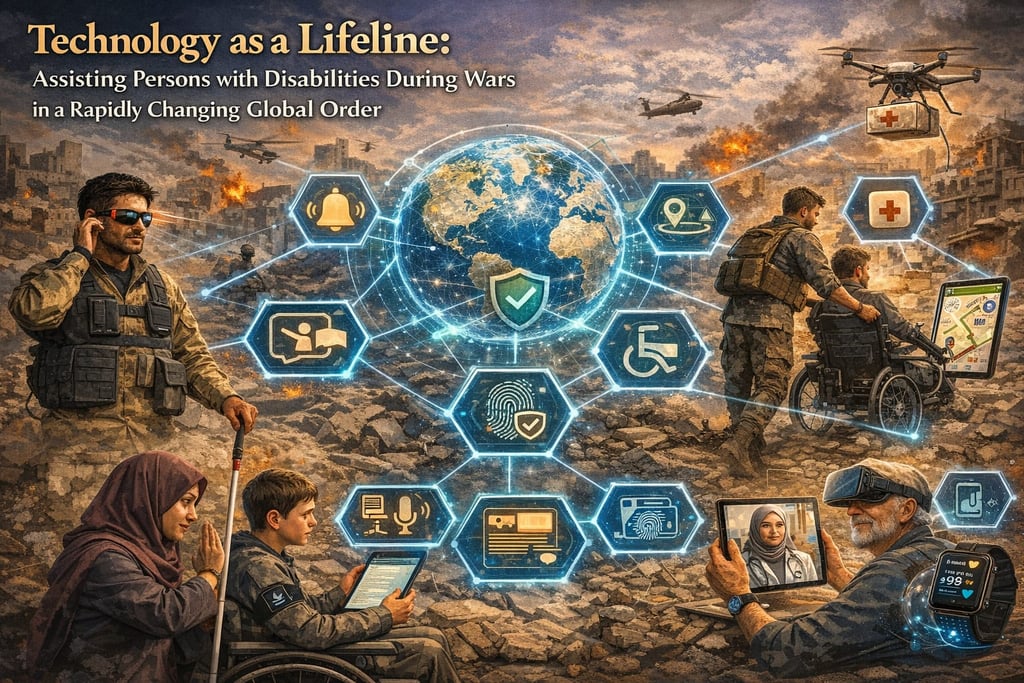
Artificial Intelligence can convert emergency alerts into accessible formats such as voice commands, vibration alerts, simplified language notifications, and sign-language-enabled visual warnings. These systems ensure that no individual is excluded from life-saving information.
2. Smart Mobility and Navigation Tools
GPS-enabled mobility applications assist wheelchair users and visually impaired individuals in identifying safe evacuation routes. Real-time mapping technologies can highlight accessible shelters, medical facilities, and humanitarian corridors during crises.
3. Remote Healthcare and Telemedicine
War zones frequently collapse healthcare infrastructure. Telemedicine platforms allow PWDs to consult doctors remotely, maintain continuity of treatment, and receive psychological support despite displacement.
Wearable health-monitoring devices can transmit vital data to humanitarian responders, enabling timely medical intervention.
4. Communication Accessibility Technologies
Speech-to-text and text-to-speech systems allow deaf and speech-impaired individuals to communicate with rescue teams. Translation technologies further bridge linguistic barriers faced by displaced disabled populations across borders.
5. Drones and Robotics for Humanitarian Assistance
Unmanned aerial vehicles (UAVs) are increasingly delivering medicines, assistive devices, and emergency supplies to inaccessible or dangerous regions. Robotics can assist in search-and-rescue operations where mobility-impaired individuals may otherwise remain trapped.
Digital Identity and Protection
Blockchain-based digital identity systems can help displaced persons with disabilities retain medical records, disability certifications, and personal documentation even when physical papers are lost during conflict. This ensures uninterrupted access to aid, rehabilitation services, and international protection mechanisms.
The Role of Inclusive Policy and Ethical Technology
Technology alone cannot guarantee protection unless guided by inclusive policymaking. Governments, humanitarian organizations, and international institutions must embed disability inclusion into defense planning, disaster preparedness, and peacebuilding strategies.
From an ethical perspective, technological innovation must align with humanitarian principles and human dignity. Inclusive design should become a global security priority rather than a charitable afterthought.
PWDs as Agents of Technological and Social Change
Importantly, persons with disabilities should not only be viewed as beneficiaries of technological assistance but as innovators, researchers, and policy contributors. Their lived experiences offer critical insights into resilience, adaptive technologies, and inclusive governance in times of crisis.
As the international system transitions toward a technology-driven security landscape, empowering disabled youth in research, artificial intelligence, and policymaking can redefine global responses to conflict.
Conclusion: Toward an Inclusive Future of Human Security
The future of warfare is increasingly digital, automated, and interconnected. Ensuring that technological progress safeguards the most vulnerable populations is both a moral responsibility and a strategic necessity.
In a rapidly changing global order, technology has the potential to transform war from a space of exclusion into one where survival, dignity, and participation remain accessible to all — including persons with disabilities.
True global security will not be measured solely by military strength, but by how effectively humanity protects those most at risk.